


At the University of Hong Kong Faculty of Law and the Central Library

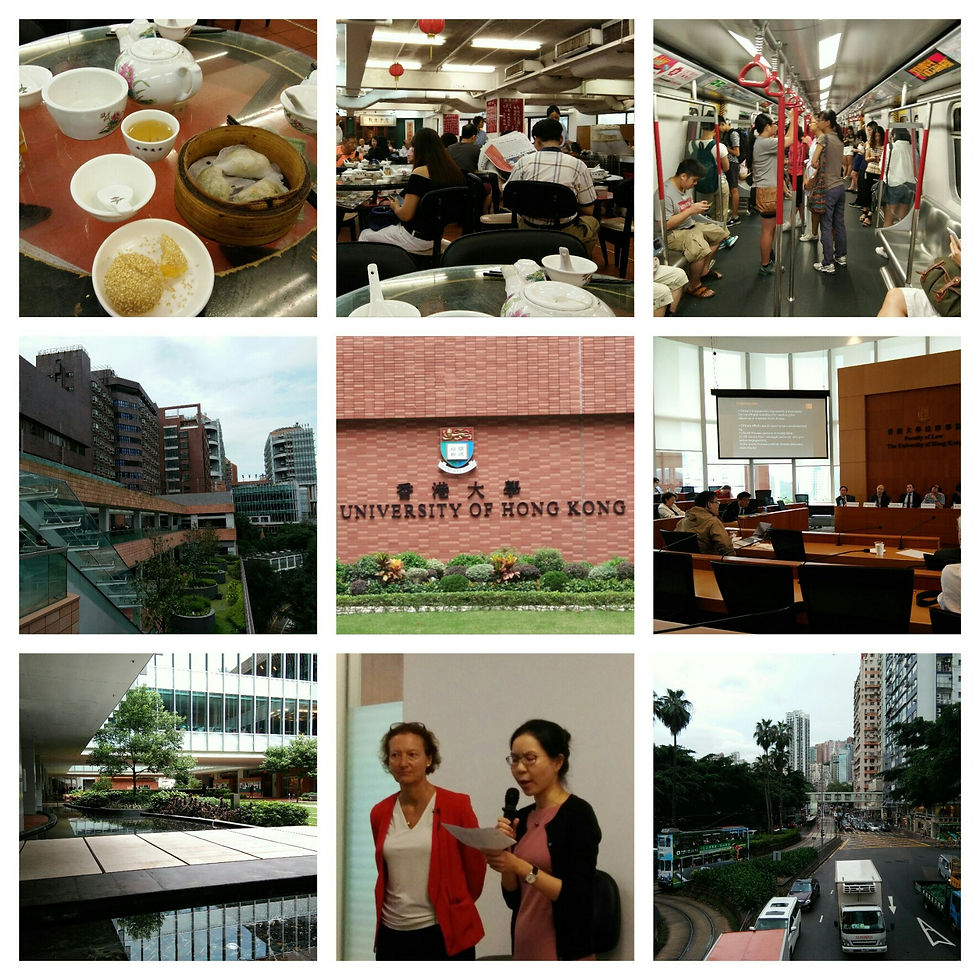
I had the opportunity to go to Hong Kong to witness the legislative elections. While there, I went to the University of Hong Kong where the school of law had a variety of seminars I was able to get invited to. Here is a list of the activities I was able to do today along with a collage showing the locations I visited.
Breakfast at Lin Heung Kui, a famous dim sum joint. It was hard to get just a fish or shrimp dumplings without pork.
Lin Heung Kui - 3 orders of dim sum and tea - $75 HK Dollars = 9 USD.
The University of Hong Kong is a private university, set amidst a spectacular backdrop of Victoria Peak, Metro Hong Kong and Victoria Harbor.
At the University of Hong Kong Law Faculty Conference Room at the Cheng Yu Tung Tower, with an expansive view of Hong Kong and Victoria Bay. The fourth panel discussed China's Role in Regional and International Financial Affairs, and the conversation went into China's ability to influence North Korea. There I met with Tat Yan Kong, PhD, the Co-Director of the London Asia-Pacific Center of Social Studies at Oxford. I mentioned to Tat that my grandfather Iwao Mori had attended Oxford in the 1920s. Tat's family was originally from Hong Kong. Tat made some interesting points on the panel regarding China's ability to influence North Korea. Due to the fact that the North Korean regime was founded partially on the basis of rooting out foreign influences in that country, after the purges of both Chinese and Russian sympathizers in the 1950s, there has been less influence by the Chinese. The Americans on the other hand, have an integrated military command structure with South Korea and very close economic ties, giving the United States considerably more influence over South Korea. Thus, the South Koreans are always finding ways of keeping the United States engaged with the Korean Peninsula. Chinese engagement with North Korea would only have meaning if accompanied by a North Korea gesture of reconciliation, US movement from "strategic patience" to active engagement, and the liberalization of the South Korean political climate.
The University of Hong Kong is an all-English campus and is accredited and recognized internationally. It is a great place for Asia studies.
Lecture by Dr. Carole J. Petersen, Professor and Director of the Matsunaga Institute for Peace and Conflict Resolution at the William S. Richardson School of Law at the University of Hawaii in Manoa. Carole discussed the topic "Democracy, Autonomy and 'One Country, Two Systems': Where is Hong Kong Going? " This was an especially timely topic as there is an election on Sunday in Hong Kong. Since the "Occupy Central" movement, there has been mounting pressure on academics and the disappearing of booksellers in Hong Kong. Much of this conflict revolves around the process of the nomination and election of the Chief Executive and legislators in achieving "universal suffrage". My question to Carole was, "if for some reason the Chinese Central Government were to hire you as an advisor during negotiations, what common ground/interests would you identify for the Central Government? Carole said that it would probably be unlikely that the Chinese would hire her, but in such an event, she thought the idea to avoid additional international scrutiny, it would be in China's interest to allow the "One Country, Two Systems" to continue. This would demonstrate to the world that China is up for the challenge of having a dialogue within the country. In addition, this would also allow the Chinese to "experiment with democracy" to see how it might apply it to other regions within China. Also attending the lecture was one of leaders of the "Occupy Central" (Central Hong Kong Island) movement in 2014, Dr. Benny Tai Yiu-ting. Benny said that in the future he would not make an ultimatum to the Central Chinese Government as it proved ineffective, though his intent was to push the limits to the left so that the moderates might have more of a chance to negotiate. Carole commented that this move only served to harden the Central Government's stance, turning the matter into a "zero-sum" game. Carole elaborated that if the Central Government backed down to a group of students in Hong Kong, what signal would that send to Tibet or to the Uyghurs?
A view from the University of Hong Kong.
The Hong Kong Central Library is one of the best places to work with a laptop as there is free wi-fi and ample outlets, a/c and a nice French café inside.
The view from my desk from the Central Library.
For more information on the University of Hong Kong, please check out http://www.hku.hk/.


Comments